
10 Essential Types of Conveyors and How to Choose the Right One for Your Industry

From manufacturing floors to distribution centres, the right conveyor system can transform throughput, safety, and overall efficiency. This guest post explores the most common conveyor types, their core applications, and the key considerations for selecting the best solution for your sector. By appreciating the strengths and limitations of each system, you can align your choice with process flow, product characteristics, and space constraints.
In practice, choosing a conveyor is more than matching a product to a machine. It requires understanding load capacity, speed, incline, durability, maintenance needs and integration with existing equipment. The following overview provides a practical framework to compare options, estimate total cost of ownership, and ensure compliant, reliable operation across your operation.
1. Belt Conveyors
Belt conveyors are among the most versatile and widely used conveyor systems. A continuous belt, typically made of rubber, PVC, or stainless steel, transports goods across distances with relatively gentle handling. They excel in processing lines requiring smooth transfer of items with varied shapes, including parcels, cartons, and bulk goods.
Key considerations:
- Load type and weight distribution
- Surface finish to minimise slippage and damage
- Curve radius and drive location to suit layout
- Belt material selection for hygiene and environmental conditions
2. Roller Conveyors
Roller conveyors use a series of rollers to move items, either powered or gravity-fed. They are ideal for uniform, stable products such as pallets, crates, and boxes. They can be adapted for accumulation, indexing, or continuous flow, depending on the drive arrangement and control strategy.
Key considerations:
- Product stability and bottom surface
- Roller pitch and diameter to handle load
- Motorisation options, including zero-pressure accumulation
- Maintenance access and bearing life
3. Chain Conveyors
Chain conveyors employ a chain-driven chain carrying lugs or slats to transport heavy, irregular, or robust items. They are robust, capable of withstanding challenging environments, and often used for manufacturing lines, automotive parts, or heavy-duty assemblies.
Key considerations:
- Material and chain design to suit products and environment
- Duty cycle and lubrication requirements
- Noise levels and maintenance scheduling
- Cleaning and hygiene, particularly in food and pharma sectors
Conveyors drive modern manufacturing, shaping efficiency and output across industries. This concept echoes deep ocean currents and climate feedbacks, where conveyor-like processes move heat and nutrients. For a detailed example, see the linked resource: https://oceanservice.noaa.gov/education/tutorial_currents/05conveyor2.html and its insights.
4. Screw Conveyors
Screw conveyors move bulk materials by rotating a helical screw inside a trough or pipe. They are well suited for powders, granules, and semi-solid materials in industries such as agriculture, cement, and chemical processing.
Key considerations:
- Material abrasiveness and cohesive properties
- Throughput, screw pitch, and speed
- Containment and dust control
- Sealing against contamination and product degradation
5. Pneumatic Conveyors
Pneumatic conveyors use airflow to transport bulk materials through a network of pipes. They are excellent for fragile or dusty materials, or when contamination must be minimised. They can convey over long distances and up inclines, often without moving parts in contact with the product.
Key considerations:
- Material characteristics (bulk density, abrasiveness, moisture)
- System pressure and energy consumption
- Leakage control and dust prevention
- Noise, maintenance, and operating costs
Conveyors streamline workflows by moving materials efficiently, reducing labor and boosting productivity across industries. From design to installation, ensuring reliability and proper maintenance is essential for long-term performance. Modern systems offer modularity, energy efficiency, and smart controls that minimize downtime. For more information about durable solutions, visit the following resource: https://conveyorrollers.co.uk to explore options and find expert guidance tailored to your needs.
6. Vibratory Conveyors
Vibratory conveyors use controlled vibration to move and sort materials along a trough or bowl. They are highly effective for separating, orienting, or feeding small parts and bulk materials that don’t sit well on traditional conveyors.
Key considerations:
- Material flow rate and particle size distribution
- Vibration frequency and amplitude control
- Cleaning and product degradation concerns
- Suitability for delicate handling or fragile components
7. Spiral Conveyors
Spiral conveyors provide vertical transport within a compact footprint, enabling gentle elevation or lowering of products in multi-level facilities. They are ideal where floor space is at a premium, such as e-commerce fulfilment or multi-storey production plants.
Key considerations:
- Throughput and cycle time per level
- Product compatibility with vertical movement
- Drive arrangement and control system
- Build quality for durable, long-term operation
8. Overhead Conveyors
Overhead conveyors suspend carriers from a track or monorail, keeping floor space free for production and storage. They suit industries requiring clean, efficient material handling, such as automotive assembly, aerospace, or food processing with dedicated hygiene standards.
Key considerations:
- Carrier design, load capacity, and tracking accuracy
- Maintenance access and corrosion resistance
- Cleaning regimes and hygiene compliance
- System integration with existing automation
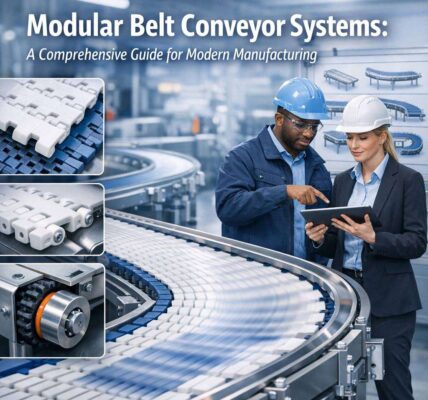
9. Modular Belt Conveyors
Modular belt conveyors use interlocking plastic modules to form a belt. They offer exceptional flexibility, easy cleaning, and simple reconfiguration for changing production lines. They are popular in packaging, food processing, and pharmaceuticals.
Key considerations:
- Module pitch, belt tension, and drive mechanics
- Cleaning and sanitation requirements
- Compatibility with washdown environments
- Customisation potential for curved or inclined layouts
10. Chain Edge Conveyors
Chain edge conveyors rely on chains along the edges to carry products via edge grip or chain-driven mounts. They provide robust handling for items that require dedicated gripping or gentle edge engagement, such as display units or delicate components.
Key considerations:
- Edge contact impact on product quality
- Tensioning and chain wear
- Noise and energy efficiency
- Availability of compatible product carriers
FAQ: Conveyors
What is a conveyor and how does it work?
A conveyor is a mechanical system designed to move materials from one place to another. It typically consists of a belt, roller, or chain driven by motors and controllers. Objects are placed on the conveyor and are transported along the belt or rollers to a designated destination.
What are the main types of conveyors?
- Belt conveyors: Use a continuous belt to carry items.
- Roller conveyors: Use rollers to move items (gravity or motorized).
- Chain conveyors: Use linked chains for heavy or irregular loads.
- Slat conveyors: Use slats linked together for rigid items.
- Screw conveyors: Move bulk materials via a rotating screw inside a trough.
- Aerodynamic/air conveyors: Use air jets or vacuum to transport lightweight items.
- Vertical conveyors: Raise or lower loads between levels.
- Modular conveyors: Use interlocking modules for flexible layouts.
How do I choose the right conveyor for my application?
Consider load weight, size, and shape; the desired speed and throughput; the environment (dust, moisture, heat); space constraints; entry and exit points; maintenance needs; and budget. A conveyor should match the load characteristics and integration with downstream equipment.
What maintenance is required for conveyors?
Regularly inspect for wear, belt tension, alignment, and idler condition. Check bearings, motors, and gearboxes, clean debris, lubricate as specified, and ensure safety guards and emergency stops are functioning. Schedule periodic audits and replace worn components proactively.
How do I calculate conveyor capacity and speed?
Capacity depends on belt width, belt speed, and load per unit length. Use manufacturer formulas or guidelines specific to the conveyor type. Factors include belt material, load distribution, and product size. For complex systems, consult an engineer or the conveyor supplier.
Are conveyors safe to operate?
Yes, when properly installed and operated with safety features such as guards, emergency stop devices, pull cords, risk assessments, and trained personnel. Follow lockout/tagout procedures and do not bypass safety interlocks.
Can conveyors be customised for unique needs?
Absolutely. Conveyors can be tailored in terms of length, curves, incline/decline, transfer mechanisms, controls, automation integration, and material compatibility to fit specific workflows.
What accessories or options are available?
- Pulleys, rollers, and idlers
- Belt types (PVC, rubber, high-temperature, food-grade)
- Diverters and transfers
- Smooth or toothed belts
- Safety guards, photoelectric sensors, and safety interlocks
- Variable frequency drives (VFDs) and controls
- Washdown and corrosion-resistant components
- Inlets, outlets, and product separators
How do I integrate a conveyor with other equipment?
Ensure compatible drive systems, control logic, and communication protocols (PLC, barcode scanners, sensors). Plan for syncing speeds, transferring products, safety interlocks, and redundancy. Often involves mechanical alignment and electrical integration.
What should I consider for food-grade or hygienic conveyors?
Choose materials that resist corrosion and are easy to clean (e.g., stainless steel, food-grade belts). Design for easy sanitation, minimise crevices, and follow applicable food safety standards (e.g., HACCP, FDA/USDA guidelines).
How long do conveyors typically last?
Lifespan varies by type, usage, and maintenance. Industrial conveyors commonly last 10–20+ years with proper maintenance. Frequent maintenance and timely replacements of wear components extend life.
Do conveyors require specialised installation?
Yes. Professional installation ensures proper alignment, tensioning, motor sizing, electrical wiring, and safety compliance. Many manufacturers offer installation and start-up services.
What is the typical lead time to purchase a conveyor?
Lead times depend on type, customisation, and configuration. Standard models may ship in a few days to weeks, while customised systems can take several weeks to months.
How can I reduce downtime with conveyors?
Invest in preventive maintenance, keep critical spare parts on hand, implement condition monitoring, use modular designs for easy upgrades, and train operators on safe operation and basic troubleshooting.
Where can I find more information or get a quote?
Contact conveyor manufacturers or distributors, review product datasheets, and request a site assessment or quotation. Providing details like load type, dimensions, environment, and throughput helps generate accurate quotes.
How to Choose the Right Conveyor for Your Industry
- Define the product: weight, dimensions, surface finish, fragility, and stacking.
- Map the process: where items start, how they move, and where outputs occur.
- Assess environment: temperature, moisture, dust, chemicals, washdown needs.
- Determine speed and throughput: required cycles per hour and peak loads.
- Evaluate space constraints: floor area, ceiling height, and turning radii.
- Consider integration: compatibility with existing controls, robotics, and ERP/MES systems.
- Plan maintenance: accessibility, spare parts availability, and service contracts.
- Budget and total cost of ownership: capital expenditure versus operating costs and lifecycle.
When selecting a conveyor system, collaborate with a reputable supplier who can provide performance simulations, installation planning, and commissioning support. A well-chosen conveyor systems solution not only improves material flow but also enhances safety, ergonomics, and uptime across your operation.
Conveyors streamline production, boosting efficiency and throughput across industries. Modern systems integrate sensors, belts, and clean design to minimize downtime. For reliable components, explore a wide selection at https://us.misumi-ec.com/vona2/mech/M1100000000/, ensuring durable conveyors tailored to your exact process requirements and budget.